What Does a Camera See That a Room Does Not?
A camera sees a seam you would never notice in a room, so a piece cut for a lens is cut to a different tolerance. It flattens depth, exaggerates texture, finds the shine in a fabric and turns fine repeating patterns into moving interference. What reads calm in the atelier can read busy on screen.
I was designer and stylist at Eurovision for three consecutive years, which is roughly the hardest version of this problem: live cameras, moving light, and no second take. Press days and red carpets are the same problem at a slower speed.
Why does a lens flatten a garment?
Because it removes one dimension and keeps all the detail.
In a room your eye reads a garment in three dimensions and forgives a lot. A slight ripple in a panel is depth. On camera that ripple becomes a line. The shape has to do its work in outline, because the lens has taken away the part of the information that made the shape obvious.
That is why pieces for camera get more structure and cleaner seaming than the same piece would need for a dinner. Fewer lines, placed exactly, and the silhouette carrying the idea rather than the detail.
What is moiré, and why does it ruin a shot?
Moiré is the shimmer you see when a fine repeating pattern meets the grid of a camera sensor. The two grids interfere and produce waves and false colour that are not on the garment at all.
Pinstripes, herringbone, tight checks and fine woven textures are the usual culprits. A statistician's write-up of why you should not wear a striped shirt on video shows the mathematics of the interference rather nicely.
The practical rule is simple. If a fabric has a repeat fine enough that you cannot resolve it from across a room, a camera will find it. That does not mean no pattern. It means testing the actual cloth on the actual lens before it becomes a garment.
What about colour and shine?
Both behave differently under a lens than under a ceiling light.
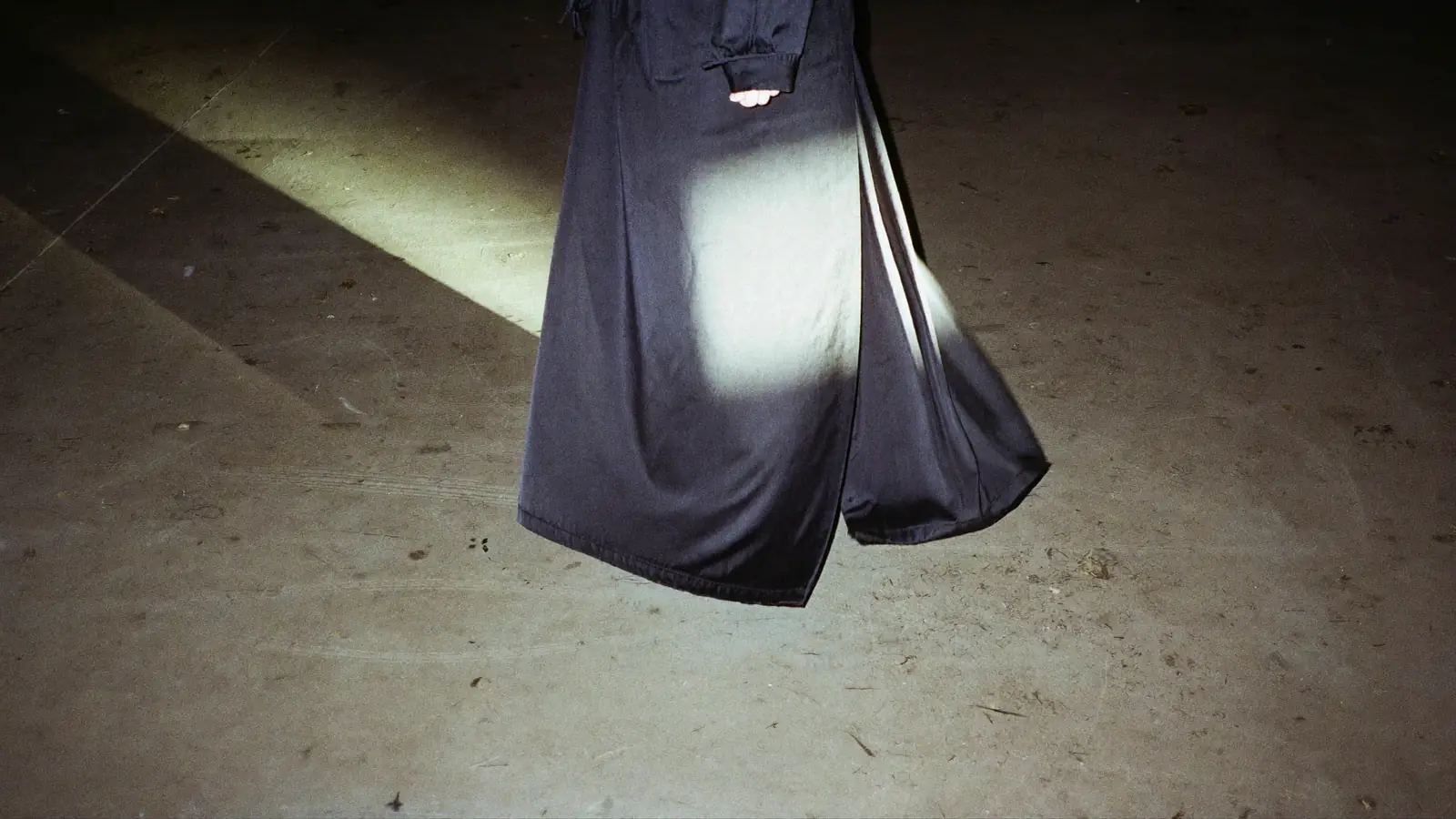
Strong shine turns into a hard white patch on camera, because a sensor has less range than an eye. Satin that looks liquid in the atelier can blow out under a flash wall on a carpet, where twenty photographers are firing at once from the same angle. Matte and semi-matte finishes hold their shape on screen.
Colour shifts too. Broadcast light, tungsten, LED panels and daylight through a window each pull a fabric in a different direction, and deep blues, deep greens and near-blacks are the ones that move most. Anything that matters gets looked at under the light it will actually be seen in.
Pure white and pure black are both worth thinking about twice. White takes the exposure with it, and black loses all the seaming that took the longest to build.
Does the inside of the garment matter on camera?
Yes, more than people expect.
Linings show through under a strong backlight. A hem weight that is invisible in a room stops a skirt from lifting into a shape you did not design. Boning and internal structure decide whether a bodice holds a clean line while you are standing still for two minutes with your hand on a hip.
And a garment for a camera has to survive standing still. Most clothes are designed for movement, but a red carpet is a lot of standing, turning, and being photographed from a low angle, and a low angle is unforgiving about a waist seam.
How is a fitting for camera different?
It happens under light, and it happens in the positions you will actually be in.
I fit the piece, then I look at it under a hard light from the side, then straight on, then from below. You stand the way you stand for a photograph. If there is time, someone takes a picture on a phone, because a screen tells you in two seconds what an eye will argue about for ten minutes.
For press, campaign and television work, fittings can happen on location, and someone can be there on the day if the schedule needs it. That is part of the camera and carpet work.
Does this apply to a wedding dress?
It does now, and most people forget it.
A wedding is one of the most heavily photographed days most people will have. Flash, video, drone shots, a hundred phones. The same rules apply: watch the shine, watch the fine repeat in a lace, think about the hem in a low-angle shot, and think about what a strong backlight does to a lining.
It is one of the reasons I ask about the venue and the time of day early. A church in February and a coast at six in the evening are different lighting jobs. You can see what bridal work looks like here.
What should you bring to the first conversation?
The occasion, the date, and if you have them, pictures of the room or the event.
Not inspiration pictures of other dresses, although those are welcome too. Pictures of the light. A carpet, a stage, a hall, a garden at the hour it will happen. That tells me more about what the cloth has to do than any reference image.
The first conversation is free and nothing is decided in it. Write to me and tell me what the picture in your head looks like, and I will tell you what a lens will do to it.
Questions people ask
Why do some fabrics shimmer strangely on camera? That is moiré. A fine repeating weave or print interferes with the camera sensor grid and produces waves and false colour that are not on the fabric itself. Fine stripes, herringbone and tight checks are the usual causes.
What colours work best on a red carpet? There is no single answer, but strong shine and pure white both risk blowing out under a flash wall, and pure black hides the seaming. Matte and semi-matte finishes hold their shape on screen.
Do you do styling as well as making? Yes. Styling and dressing for press, campaigns, red carpet and television are part of the atelier, including fittings on location.
Have you worked on live television? Yes. I was designer and stylist at Eurovision for three consecutive years, and I spent years as a wardrobe tailor on tour.
Should a wedding dress be cut for the camera? It should at least be considered. A wedding is heavily photographed, and shine, fine lace repeats and backlit linings all behave differently on camera than in the room.
By appointment only · Currently Amsterdam · Online meetings welcome