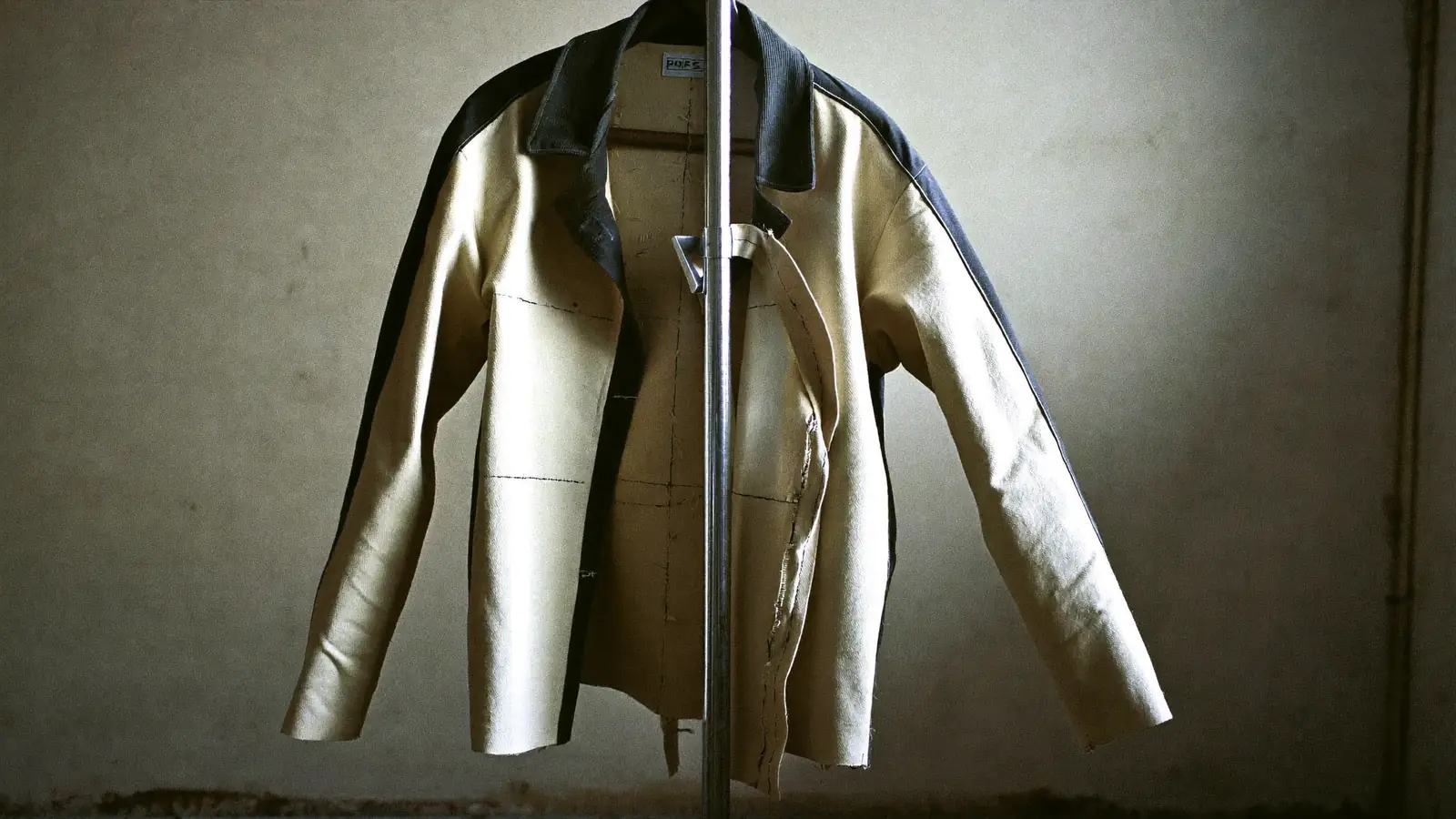
Why Is a Pattern Drawn From a Body and Not From a Category?
Most of what I make is for women. But a pattern is drawn from a body and not from a category, so tailoring for men is part of this atelier too. The measurements are the same, and so is the method. What changes is the body in the room.
The trade split itself into two worlds a long time ago, and a lot of people still get sent to the wrong side of it. So it is worth saying plainly what actually differs.
Why did tailoring split into two trades at all?
History and guilds, mostly, rather than anatomy.
Tailoring and dressmaking developed as separate crafts with separate training, separate tools and separate vocabulary. The background on bespoke tailoring shows how much of that structure is inherited rather than technical. The result is that a jacket goes to one trade and a dress goes to another, and a woman who wants a jacket built like a jacket often finds herself in a shop that treats it as a dress with lapels.
I trained in design and in tailoring, which were two different journeys and I went on both. One taught me how to see a garment before it exists. The other taught me how to build it so it holds. That is why the two things sit on one table here.
What is actually the same?
Almost everything that decides the outcome.
The conversation about what the garment is for. The measurements. The toile in plain cotton, marked and taken apart until the shape is right. Cutting the cloth only when the toile is right. Three fittings for a couture piece. The pattern kept afterwards, drawn from one body and used for nobody else. The five steps do not change.
The tolerances are the same too. A shoulder that is half a centimetre out is half a centimetre out on anyone.
What actually differs?
The construction question, not the gender.
A structured jacket is built around an internal architecture: canvas, padding, a shoulder that has to hold a line whether the arm is up or down. That architecture is the same craft whoever wears it, and it is what makes a jacket a jacket rather than a coat-shaped garment.
Where bodies differ, the pattern differs, and that is true within a category as much as across one. A sloped shoulder, a long rise, a full chest, an uneven hip, a strong back from years of training: those are the things that move a pattern. None of them are questions about a category. They are questions about the person standing in front of me.
What do most bodies not fit?
The size standard, which is the whole reason any of this exists.
Off the rack starts from an average and then subtracts. Almost every shoulder slopes more on one side. Very few waists sit exactly where a block assumes. A body that trains changes shape in ways that no grading rule anticipates, which I know because I compete in bikini fitness and my own measurements have moved a long way from anything a size chart describes.
There is no such thing as a standard body. There is no reason a garment should be standard either.
What does a man usually come here for?
A jacket, a suit for an occasion, or a piece for a stage or a camera.
The jacket is the common one, and the reason is nearly always the same: a shoulder that no rack size gets right, or a chest and a waist that belong to two different sizes. Both of those are pattern problems, and a pattern drawn from the body solves them at the source rather than by alteration.
The occasion suit is the other. A wedding, a season, a set of appearances. The camera work is the third, and a piece for a lens is cut to a different tolerance because a camera sees a seam you would never notice in a room.
Is there a separate men's service?
No, deliberately.
There is no separate page, no separate menu item and no separate process, because there is no separate process. Making men's tailoring a side department would suggest it is a variation on the main work, and it is not. It is the same work.
What that means practically is that you get the same thing: a conversation, measurements, a toile, three fittings, and a pattern that belongs to you and stays here. The commissions in the atelier at any one time are a mixture, and they get the same table.
How do you know if it is worth commissioning?
If alterations have stopped working, it is worth commissioning.
That is the honest test. If a good alteration tailor can get an off the rack jacket to sit properly on you, do that: it is faster and cheaper and there is nothing noble about spending more. If you have been told a shoulder cannot be fixed, or you keep buying for one measurement and living with another, then the pattern is the problem and only a new pattern solves it.
The first conversation is free and nothing is decided in it. You can see the couture and tailoring work here, read how the atelier works, or write to me and describe what has never fitted.
Questions people ask
Do you make clothes for men? Yes. Most of the work is for women, but a pattern is drawn from a body and not from a category, so tailoring for men is part of the atelier.
Is the process different for men's tailoring? No. Conversation, measurements, a toile in plain cotton, three fittings for a couture piece, and the pattern kept afterwards. The same five steps.
What is the difference between a tailor and a dressmaker? Historically they were separate trades with separate training and tools. Structurally, tailoring builds an internal architecture of canvas and padding, and dressmaking works more from drape. I trained in both.
Should I get a jacket altered or made? Get it altered if an alteration tailor can make it sit properly. Commission it if the problem is in the shoulder or the pattern, because alterations cannot move what the pattern got wrong.
Can a suit be made for a body that changes shape? Yes, and it is worth saying so early. Your pattern stays in the atelier, so a later alteration or a second piece starts from a shape that already fits you.
By appointment only · Currently Amsterdam · Online meetings welcome