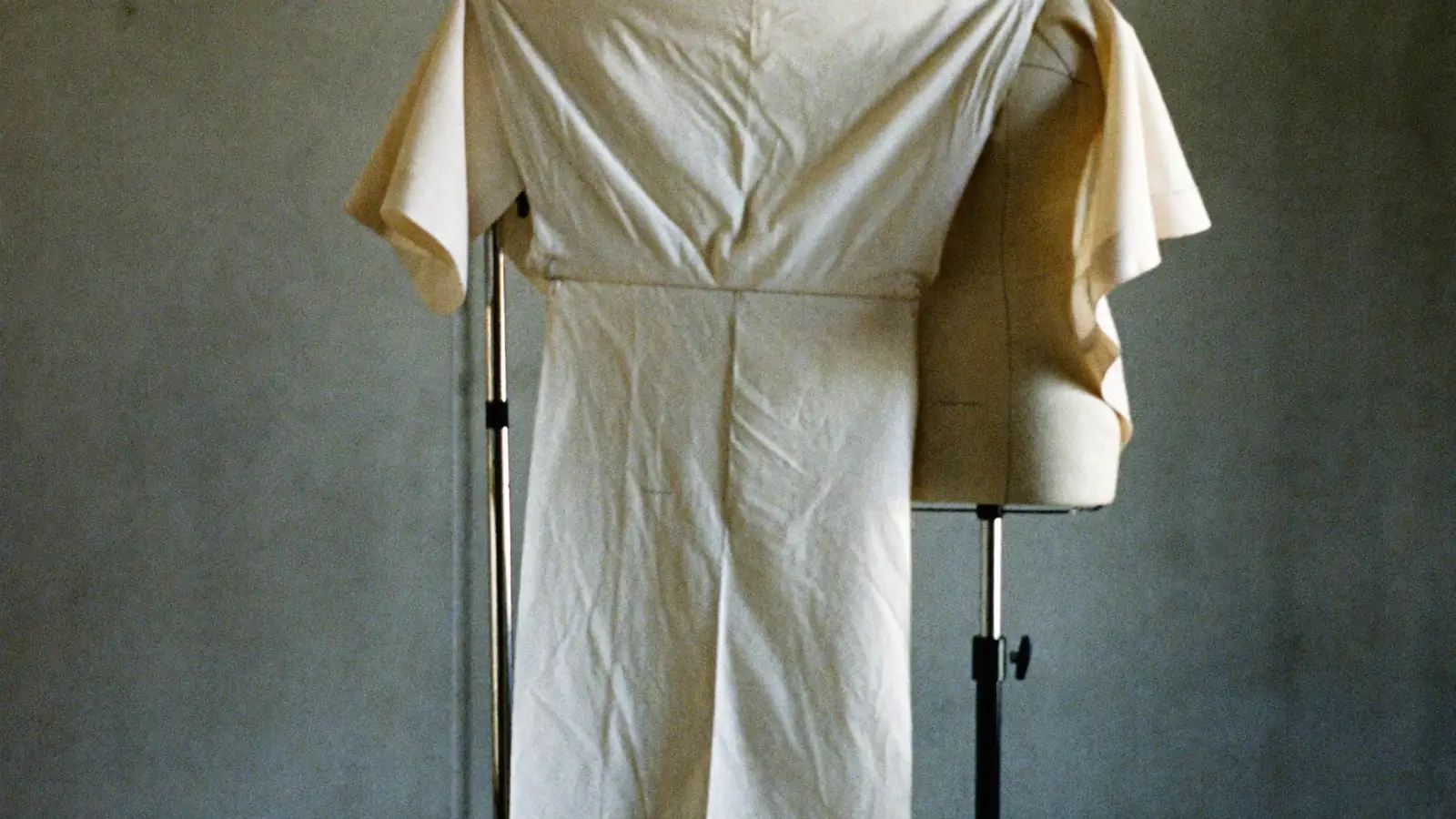
What Is a Toile, and Why Does It Decide Everything?
A toile is a full version of your garment cut in plain cotton, made before anything is cut in the real cloth. It exists to be marked, taken apart and cut again. It is the least glamorous stage of the work and it decides how the finished piece sits. Nothing goes into silk until the toile is right.
I make one at the start of almost every commission. Clients are sometimes surprised by it. They came for a dress and the first thing they see is unbleached cotton with chalk lines on it. That cotton is the reason the dress will fit.
What is a toile actually made of?
Plain cotton. Calico, or what an American tailor would call muslin. It is cheap, it is stable, it holds a chalk line, and it behaves enough like real cloth to tell the truth about a shape. The Fashion History Timeline at FIT traces the habit back through the trade: designers and tailors have worked out their patterns in muslin for so long that the mock-up took the name of the fabric.
I use it because it is honest and because I am allowed to ruin it. A toile that comes back from a fitting clean is a toile that was not used properly.
Why not just take good measurements?
Because measurements describe a body at rest, and nobody wears clothes at rest.
A tape measure will tell me a shoulder is a certain width. It will not tell me that the shoulder slopes more on one side, which almost every shoulder does. It will not tell me where the weight of a skirt will pull, how far you raise your arms when you talk, or that a seam I drew on paper wants to fall two centimetres further back than the drawing says.
There is no such thing as a standard body. A pattern drawn from numbers alone is a guess with decimals on it. The toile turns the guess into a fact.
What happens at a toile fitting?
You put it on. I look. Then I start cutting into it.
I slash a seam that is fighting the body and let it fall where it wants. I pin out fullness that does not belong. I raise a neckline, drop an armhole, move a dart. I draw on it in pencil. You walk in it, sit down in it, put your arms above your head in it. If it is a wedding dress you sit down properly, because you will spend a good part of that day sitting.
Then I take it off you, take it apart at the seams, and lay the pieces flat. Those flat pieces are the corrected pattern. That is the whole trick: the toile is not a rehearsal for the dress, it is the tool that draws the pattern.
How long does the toile stage take?
It varies with the piece. A simple column takes less time than a structured bodice with boning in it, and a wedding dress usually takes more than one round.
What I can say is that it is time you get back later. Every hour spent on cotton is an hour not spent unpicking silk. The full commission runs one to six months from the first conversation to the finished piece, depending on the model, the design and the cloth, and the five steps are set out here.
What does the toile save you?
Money, mostly, and the design.
Silk gazar and duchesse satin are not forgiving. A needle hole in fine cloth stays a needle hole. Once you have cut into a length of good fabric you have spent it, and if the shape turns out to be wrong you have spent it twice. The toile means the expensive cloth is only ever cut once, from a pattern that has already been proved on your body.
It also saves the idea. Things that look right on paper sometimes look wrong on a person, and things you would never have drawn turn out to suit you. The toile is where that gets discovered, while it still costs nothing but cotton and time.
Why is the toile the moment to change your mind?
Because it is the last moment where changing your mind is free.
At the toile stage you can shorten a sleeve, open a back, take a neckline three centimetres wider or decide the skirt wants more weight in it. None of that changes the price and none of it changes the delivery date. It costs cotton.
After the toile is approved and the real cloth is cut, a change is a different animal. It can move the price and it can move the date, and you will hear that from me before anything happens. That is written into the terms in plain language, because a garment made for one person deserves an agreement you can actually read.
So when you are standing in cotton and something is nagging at you, say it. That is what it is for.
Does every piece get a toile?
Almost every one. A wedding dress always does, and usually more than one round of it. Evening and occasion pieces do, which is most of the couture work. Tailoring does, because a jacket lives or dies on the shoulder and the shoulder is not something you guess at.
The pattern that comes out of your toile stays in my atelier afterwards. It is never sold and never used for anyone else. If you come back, we start from a shape that already fits you, and the second piece is faster than the first for exactly that reason.
Questions people ask
What is a toile? A full version of a garment cut in plain cotton, made to be marked, taken apart and cut again. It is fitted on the person who will wear the finished piece, and the corrected cotton pieces become the pattern.
Is a toile the same as a muslin? Yes. Toile is the French and British word, muslin is the American one, and both refer to the same practice garment in cheap cotton.
Do I have to come in for the toile fitting? Yes. The toile only does its job on the body it was cut for. I am in Amsterdam and fittings are by appointment. Early conversations can happen online, but the toile fitting is in the room.
Does the toile cost extra? No. It is part of how the piece is made, and three fittings are included in the price of a couture commission.
What happens to the toile afterwards? It gets taken apart and becomes your pattern. The pattern stays in the atelier, and it is there if you come back. You can read how the atelier works here, or write to me if you want to talk a piece through.
By appointment only · Currently Amsterdam · Online meetings welcome